AI Keyword Research: How AI Changes the Way You Find Keywords
· 8 min read · JackpotKeywords Team
Traditional keyword tools make you guess seed keywords. AI keyword research tools understand your product and find opportunities you would never think to search for.
Key Takeaway: AI keyword research eliminates the biggest problem with traditional tools — you do not need to already know what keywords to search for. Describe your product in plain English, and AI discovers keywords across intent categories you would never find through manual seed expansion. Combined with real Google data, it provides both discovery breadth and metric accuracy.
The way people do keyword research is fundamentally changing. Traditional tools assume you already know your market well enough to enter seed keywords. AI-powered tools flip this model — you describe what you sell, and the AI figures out what people search for when they need it.
This shift matters because the most valuable keywords are often the ones you would never think to search for. A project management tool company might focus on "project management software" but miss thousands of searches from people describing their problems instead of their solutions.
The Problem with Traditional Keyword Research
Every keyword research tool works roughly the same way: you type in a seed keyword, and the tool returns related keywords with search volume and competition data.
The problem is obvious once you think about it — you have to already know what to search for.
If you sell a project management tool and you type "project management software," you get variations of that phrase. But what about the frustrated team lead searching "how to stop missing deadlines"? Or the startup founder googling "best way to track product launch tasks"? Those are real potential customers, but you would never find them by starting with "project management software."
Traditional tools are keyword-in, keywords-out. They cannot understand your product, your customers' problems, or the search behavior of people who need what you sell but do not know what it is called.
What AI Keyword Research Actually Does
AI keyword research flips the process. Instead of starting with keywords, you start with your product:
- You describe what you sell — in plain English, the way you would explain it to a friend
- AI understands the product — it identifies features, use cases, pain points, competitors, target audience, and related topics
- AI generates keyword seeds — not just variations of one phrase, but keywords across every angle someone might search from
- Real data enriches the results — each keyword gets actual search volume, CPC, and competition from Google Ads data
The difference is structural. A traditional tool explores one keyword tree. AI explores the entire forest of search behavior around your product.
The 12 Intent Categories
When AI understands your product holistically, it can generate keywords across fundamentally different search intents:
- Direct — What someone types when they know they want your type of product ("project management tool")
- Feature-based — Searches for specific capabilities ("task assignment software," "gantt chart tool")
- Problem-based — Searches driven by pain points ("how to stop missing deadlines," "team collaboration problems")
- Audience-based — Role or industry-specific searches ("project management for startups," "marketing team task tracker")
- Competitor brands — People searching for your competitors by name
- Competitor alternatives — People actively looking to switch ("[competitor] alternative," "[competitor] vs [competitor]")
- Use case — Specific scenarios ("manage product launch tasks," "track freelance projects")
- Industry/niche — Vertical-specific terminology ("construction project management," "agency workflow tool")
- Benefit/outcome — Result-oriented searches ("save time on project tracking," "reduce missed deadlines")
- Adjacent — Related interests of your target audience ("team communication tools," "time tracking software")
- Seasonal — Holiday and time-specific keywords when relevant
- Local — Geographic keywords for location-specific businesses
A traditional tool starting with "project management software" would find keywords in maybe 2-3 of these categories. AI finds them in all 12.
What AI Cannot Do (and Where Real Data Matters)
AI is not magic. There are important limitations:
AI cannot tell you search volume. It can suggest that "how to stop missing deadlines" is a keyword people might search for, but it has no idea if 10 people or 10,000 people search for it monthly. That requires real data from the Google Ads API.
AI cannot tell you CPC or competition. How much does that keyword cost to advertise on? How many other advertisers are bidding on it? Only real advertiser data answers these questions.
AI can hallucinate keywords. It might suggest keywords that sound plausible but nobody actually searches for. Without search volume data to validate, you could optimize for phantom keywords.
This is why the best AI keyword tools combine AI generation with real data enrichment. AI finds the opportunities. Data confirms which ones are real.
ChatGPT vs. Dedicated AI Keyword Tools
A common question: "Can I just use ChatGPT for keyword research?"
You can use ChatGPT to brainstorm keyword ideas, and it is better than nothing. But there are significant gaps:
| ChatGPT | Dedicated AI Keyword Tool | |
|---|---|---|
| Keyword generation | Good brainstorming | Structured across 12 categories |
| Search volume | None — it guesses | Real Google Ads data |
| CPC data | None | Actual advertiser bid ranges |
| Competition level | None | LOW / MEDIUM / HIGH from Google |
| Trend data | None | 12-month historical trends |
| Scoring | None | Jackpot Score combining all factors |
| Export to Google Ads | No | Direct export in Ads Editor format |
ChatGPT gives you a list of words. A dedicated tool gives you a scored, categorized, data-backed strategy.
How JackpotKeywords Uses AI
JackpotKeywords is built on this AI-first approach. Here is the pipeline:
Step 1: Product understanding. You describe your product (or paste a URL). AI extracts structured information: what it does, who it is for, what problems it solves, who the competitors are, key features, and related topics.
Step 2: Multi-category seed generation. AI generates 50-70+ keyword seeds across all 12 intent categories, using the structured product understanding. A second pass checks for weak categories and fills gaps.
Step 3: Real data enrichment. Every seed keyword is sent to the Google Ads Keyword Planner API. We get back actual monthly search volume, CPC ranges, competition levels, and related keywords that Google suggests. This typically expands the list to 500-1,000+ keywords.
Step 4: Multi-platform expansion. Keywords are expanded using autocomplete data from Google, YouTube, Amazon, eBay, and Bing — surfacing long-tail variations that keyword databases miss.
Step 5: Scoring and classification. Every keyword gets a Jackpot Score (0-100) combining volume, CPC, competition, trends, and relevance. Keywords are classified by search intent (informational, commercial, transactional, navigational) and organized into clusters.
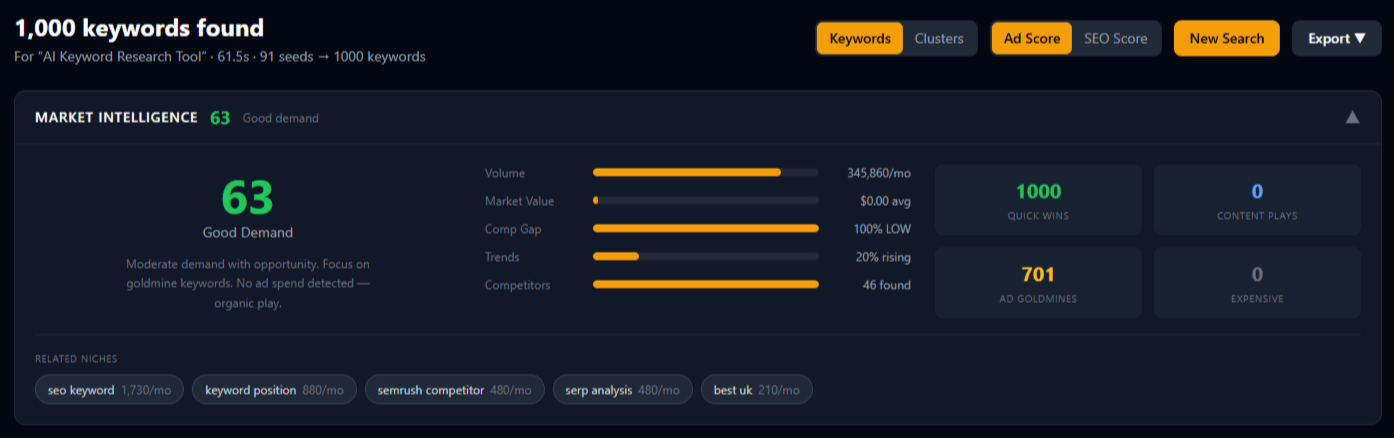
The result: 1,000+ keywords with real data, organized by intent, scored by opportunity, ready to act on. From a plain English description. In under 60 seconds.
When to Use AI Keyword Research
AI keyword research is most valuable when:
- You are launching a new product and do not know what keywords to target yet
- You are entering a new market and need to understand how people search in that space
- You have been using the same keywords for years and want to discover what you are missing
- You are a small business owner without SEO expertise who needs actionable keywords without learning keyword research methodology
- You want competitor keywords but do not want to reverse-engineer domains one at a time
For a broader look at how AI tools compare to traditional keyword platforms, see our SEO keyword analysis tools guide. If you want to understand the tool that AI keyword research replaces and supplements, our Google Keyword Planner guide covers the traditional approach in detail. And for strategies on acting on the keywords you discover, our guide to finding low competition keywords walks through the validation and content planning process.
Frequently Asked Questions
What is AI keyword research?
AI keyword research uses artificial intelligence to discover keywords from a product or service description rather than requiring you to enter seed keywords manually. The AI understands your market context — your product type, target audience, competitors, and use cases — and generates keyword opportunities across multiple intent categories that seed-based expansion tools cannot reach. It is particularly valuable for new products, niche markets, and businesses entering unfamiliar search landscapes.
Is AI keyword research better than traditional keyword tools?
AI keyword research solves the cold-start problem that traditional tools have — you do not need to already know your keywords to find new keywords. This makes it better for discovery and entering new markets. Traditional tools like SEMrush and Ahrefs are better for deep analysis of specific keywords you already know about, especially when combined with backlink data, rank tracking, and domain analysis. The ideal workflow uses AI for discovery and traditional tools for ongoing monitoring.
Does JackpotKeywords use AI for keyword research?
Yes. JackpotKeywords uses Gemini AI to analyze your product description, identify your market and competitors, and generate seed keywords across 12 intent categories (direct, feature-based, problem-based, audience, competitor brands, alternatives, use case, industry, benefit, adjacent, seasonal, and local). Every keyword is then enriched with real Google Ads API data including exact monthly volume, CPC ranges, competition level, and trend direction. The AI handles the creative discovery while Google's data provides the quantitative metrics.
Try It Free
JackpotKeywords gives you 3 free searches. Describe your product in plain English and get 1,000+ scored keywords with real Google Ads data in under 30 seconds. No keyword expertise needed.
Already have a website? Run a free SEO audit to check 20+ ranking factors and find what is holding your site back.