How to Find Low Competition Keywords That Rank
· 9 min read · JackpotKeywords Team
A practical guide to finding low competition keywords with real search volume. Learn what makes a keyword low competition and how to validate before investing.
Key Takeaway: Low competition keywords are search terms where you can realistically rank on page 1 without an established domain or extensive backlinks. The key is combining Google's competition rating with manual SERP analysis — a keyword rated LOW in Google Ads data that also shows weak results on page 1 is a genuine opportunity.
Low competition keywords are the foundation of every successful SEO strategy for small businesses, new websites, and bootstrapped startups. Targeting high-volume, high-competition keywords when you are a new site is like entering a marathon as your first run — you will exhaust yourself and finish nowhere near the front. Low competition keywords let you build traffic, authority, and revenue incrementally while larger competitors focus elsewhere.
The challenge is finding keywords that are genuinely low competition rather than just low quality. A keyword with zero competition often has zero competition because nobody searches for it. The goldmine is keywords with meaningful search volume (100-2,000+ monthly searches) where the existing search results are weak enough for a new or smaller site to compete.
What Makes a Keyword Low Competition?
Competition is not a single metric — it is a combination of signals that together indicate how difficult it will be to rank on page 1 for a given keyword.
Google Ads competition rating is the most accessible signal. Google rates every keyword as LOW, MEDIUM, or HIGH competition based on how many advertisers bid on it. While this is an advertising metric rather than an SEO metric, there is strong correlation. Keywords that few advertisers bid on tend to also have fewer dedicated SEO pages targeting them. Our guide to finding profitable keywords explains how to use this data for prioritization.
SERP quality is the most reliable signal. Search for the keyword in Google and examine the top 10 results. If you see forums (Reddit, Quora), product listing pages, outdated content, thin pages under 500 words, or results that do not directly answer the query, the keyword is genuinely low competition. If you see comprehensive guides from major publications (Forbes, HubSpot, Ahrefs blog), the competition is real regardless of what any tool says.
Domain authority of ranking pages indicates how established the current competitors are. If pages from small blogs, niche sites, and medium-sized businesses rank on page 1, a comparable site can compete. If every result comes from domains with millions of backlinks and decades of authority, the keyword is effectively high competition even if the Google Ads data says otherwise.
Number of pages specifically targeting the keyword matters. Search for the keyword in quotes ("exact match keyword") to see how many pages contain that exact phrase. Under 50,000 results generally indicates low competition. Over 500,000 results indicates significant competition, though this metric alone is not definitive.

How Do You Check Keyword Competition Accurately?
The most reliable competition assessment combines automated data with manual SERP inspection. No tool alone gives you the full picture, but a structured process gets you close in under five minutes per keyword.
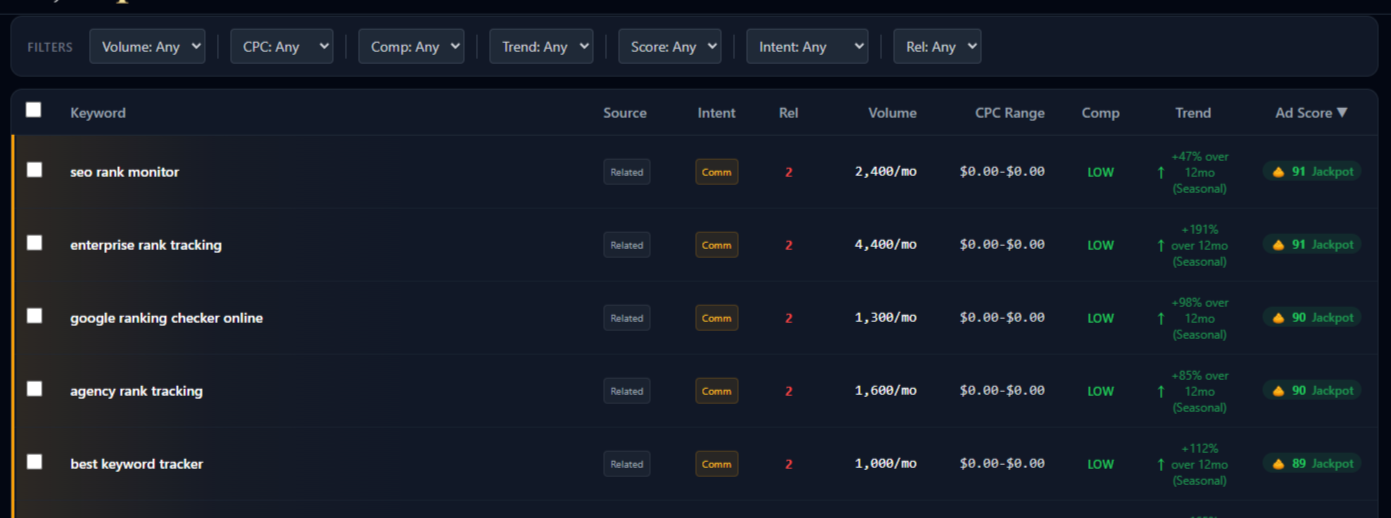
Start with your keyword tool's competition rating. In JackpotKeywords, every keyword includes a Google Ads competition level (LOW, MEDIUM, HIGH) alongside volume, CPC, and trend data. The Jackpot Score automatically factors competition into its 0-100 rating, surfacing keywords that combine strong volume with low competition. Filter your results by LOW competition to immediately narrow your list.
Next, check the specific volume and trend. A LOW competition keyword with 50 monthly searches that is declining is not worth your time. A LOW competition keyword with 500 monthly searches that is rising is worth writing 2,000 words about today. Our beginner's guide to keyword research covers how to read these metrics.
Then do the manual SERP check for your top candidates. Open Google in an incognito window (to avoid personalized results) and search for the keyword. Ask yourself three questions about the top 5 results:
Could I create something better than what currently ranks? If the top results are short, outdated, poorly structured, or do not directly answer the searcher's question, you have a clear content opportunity.
Are the ranking domains in my league? If small to medium sites rank, you can compete. If only massive authority domains appear, move on to your next candidate.
Do the results actually target this keyword? Sometimes the top results rank for a keyword incidentally rather than intentionally. If no page in the top 10 has the keyword in its title tag and H1, a page that specifically targets the keyword has a structural advantage.
Where Do You Find Low Competition Keywords with High Volume?
The intersection of low competition and meaningful volume is where the real opportunities live. Several approaches consistently surface these keywords.
Long-tail expansion is the most reliable method. Take a broad keyword in your niche and add modifiers — "for beginners," "for small business," "2026," specific product types, specific use cases. "Keyword research" is extremely competitive. "Keyword research for Etsy sellers" is much less competitive while still carrying meaningful volume. Our guide on keyword research for new websites applies this principle systematically.
Question-based keywords tend to have lower competition because they are more specific. "How to find keywords for a new blog" is less competitive than "keyword research" while clearly signaling what the searcher needs. People Also Ask boxes in Google search results are a free source of question keywords that real people search for.
Niche and industry-specific terms naturally filter out generic competition. "CRM software" is fiercely competitive. "CRM for real estate agents with MLS integration" is likely low competition because only sites in the real estate tech niche target it.
Rising keywords are low competition by definition — they are too new for established sites to have targeted them. Monitoring trend data in your keyword tool reveals keywords that are growing rapidly but have not yet attracted competitive attention. A keyword rising 50-100% year over year that currently gets 200 monthly searches could be getting 400-600 searches within a year, and ranking early means you are established when the volume arrives.
| Strategy | Example | Typical Competition | Typical Volume |
|---|---|---|---|
| Long-tail modifier | "keyword research for Etsy sellers" | LOW | 100-1,000 |
| Question format | "how many keywords should I target per page" | LOW | 200-2,000 |
| Industry-specific | "SEO for dental practices" | LOW-MEDIUM | 100-500 |
| Rising keyword | Trending niche term | LOW (early) | 50-500 (growing) |
| Location + service | "SEO consultant Portland Oregon" | LOW | 50-200 |
The beauty of low competition keywords is that their value compounds. Ten pages each targeting a 300 search-per-month keyword collectively drive 3,000 monthly visits. Twenty such pages drive 6,000. Each page also tends to rank for additional related keywords beyond its primary target, multiplying the total traffic. For strategies on grouping related keywords into topic clusters, see our keyword clustering guide.
How Do You Validate a Keyword Before Writing Content?
Finding a low competition keyword is only half the work. Before investing time in creating a page — writing 1,500-2,500 words, optimizing the title and meta description, building internal links — validate that the keyword is worth the effort.
Confirm the volume is real. If you found the keyword through a free tool that uses estimated data, cross-reference with a tool that uses Google Ads API data to confirm the volume is not inflated. A keyword showing 2,000 monthly searches in an estimation-based tool might actually get 400 searches in Google's data. JackpotKeywords and Google Keyword Planner both provide Google-sourced numbers, though Keyword Planner shows ranges for free accounts.
Check the trend direction. A keyword with 500 monthly searches and a declining trend will have fewer searches next year. A keyword with 300 monthly searches and a rising trend will have more. When two keywords have similar volume and competition, the rising keyword is almost always the better investment.
Assess the commercial value. Low competition is most valuable when the keyword has commercial intent — the searcher is looking to buy, compare products, or solve a problem your product addresses. A low competition informational keyword ("what is keyword density") drives traffic but may not drive revenue. CPC data is a useful proxy: if advertisers pay for a keyword, it has commercial value. Our guide on finding good SEO keywords covers this evaluation in depth.
Plan the content before committing. Outline what your page will cover, check that you can provide genuine value beyond what currently ranks, and ensure the topic fits your site's expertise. A dental practice blog writing about cryptocurrency keywords will not rank well even if the keyword is low competition, because Google evaluates topical authority.
Set expectations for timeline. Even genuinely low competition keywords take time to rank. A new page typically appears in search results within 2-4 weeks and reaches page 1 within 2-4 months. Track your target keywords monthly using Google Search Console's Performance report to monitor progress. If after 3 months you have not broken into the top 30, reassess the competition level — it may be higher than your initial analysis suggested.

Frequently Asked Questions
What makes a keyword low competition?
A keyword is low competition when few authoritative websites specifically target it, Google Ads competition is rated LOW, the top-ranking pages have low domain authority and few backlinks, and the search results show forums or thin content rather than comprehensive guides. These signals together indicate you can rank with quality content even from a newer or smaller domain.
How many searches per month is good for a low competition keyword?
For a small business or new website, keywords with 100 to 1,000 monthly searches are the sweet spot. They have enough volume to drive meaningful traffic but not so much that established sites compete aggressively. Ten pages each targeting a 300 search-per-month keyword can drive 3,000 monthly visits collectively — significant for most small businesses.
How long does it take to rank for low competition keywords?
New pages targeting genuinely low competition keywords typically begin appearing in search results within 2 to 4 weeks and can reach page 1 within 2 to 4 months. Established domains with existing authority may rank faster. High competition keywords can take 6 to 12 months or longer to reach page 1 even with strong content and backlinks.
Can you find low competition keywords for free?
Google Keyword Planner shows competition levels at no cost, and Google Autocomplete suggests long-tail variations that are naturally lower competition. JackpotKeywords offers 3 free searches that include competition data, Jackpot Scores prioritizing low-competition opportunities, and trend data for 1,000+ keywords per search. That is typically enough to identify dozens of low competition targets across your niche.
Ready to find the low competition keywords in your market? JackpotKeywords surfaces goldmine opportunities automatically — keywords with real volume, low competition, and rising trends. Describe your product, get scored results in 30 seconds. Three searches are free.