What Is Keyword Research? A Complete Beginner's Guide
· 8 min read · JackpotKeywords Team
Learn what keyword research is, why it matters, and how to find the right keywords for your business — no SEO expertise required.
Key Takeaway: Keyword research is the process of discovering what your potential customers actually search for online, how often they search for it, and how hard it is to compete for those searches. It is the foundation of both SEO and paid advertising — without it, you are guessing.
Keyword research answers the most fundamental question in digital marketing: what are people actually looking for? Every time someone types a query into Google, YouTube, or Amazon, they are expressing a need. Keyword research reveals those needs in aggregate — showing you not just what people search for, but how many people search for each term, what they are willing to pay for clicks, and whether demand is growing or shrinking.
If you are new to SEO or online marketing, this guide explains everything you need to know about keywords, the metrics that matter, and how to find the right keywords for your business without needing technical expertise.
What Is a Keyword?
A keyword is any word or phrase that someone types into a search engine. When you Google "best running shoes for flat feet," that entire phrase is a keyword. When someone searches "pizza near me," that's a keyword too.
Keywords are the bridge between what people are looking for and the content, products, or services you offer. Understanding which keywords matter to your business is the foundation of both SEO (search engine optimization) and paid advertising.
What Is Keyword Research?
Keyword research is the process of discovering what your potential customers are actually searching for. It answers three critical questions:
- What are people searching for in your space?
- How many people search for each term per month?
- How hard is it to rank for or advertise on each term?
Without keyword research, you're guessing. You might optimize your website for terms nobody searches for, or waste ad budget on keywords that are too expensive to be profitable.
Why Does Keyword Research Matter?
Here's a real example. Imagine you sell handmade candles online. You might think "candles" is a great keyword to target. But look at the data:
| Keyword | Monthly Searches | CPC | Competition |
|---|---|---|---|
| candles | 301,000 | $1.12 | HIGH |
| soy candles handmade | 2,400 | $0.45 | LOW |
| best candles for relaxation | 1,900 | $0.38 | LOW |
| candle gift set for her | 880 | $0.52 | LOW |
"Candles" has massive volume, but the competition is brutal — you'd be fighting against Yankee Candle, Bath & Body Works, and Amazon. Meanwhile, "soy candles handmade" has 2,400 searches per month with almost no competition. That's a goldmine keyword.
This is exactly what keyword research reveals: where the opportunity actually is.
What Are the 5 Key Metrics in Keyword Research?
1. Search Volume
How many people search for this keyword per month. Higher isn't always better — a keyword with 500 monthly searches and no competition can be more valuable than one with 50,000 searches and fierce competition.
2. CPC (Cost Per Click)
What advertisers pay per click on Google Ads. Even if you're doing SEO (not paid ads), CPC tells you how valuable a keyword is. High CPC = high commercial intent = people ready to buy.
3. Competition Level
How hard it is to rank or advertise for this keyword. Keywords are rated LOW, MEDIUM, or HIGH competition. As a small business, you want to start with LOW competition keywords.
4. Search Intent
Why someone is searching. Are they looking to buy (transactional), compare options (commercial), learn something (informational), or find a specific website (navigational)? Matching intent to your content is crucial.
5. Trends
Is this keyword growing or declining? A keyword with 500 monthly searches that's rising 20% month-over-month is more valuable than one with 2,000 searches that's declining.
How Do You Do Keyword Research (The Easy Way)?
Traditional keyword research requires you to already know what keywords to search for — which defeats the purpose. Tools like SEMrush ($140/mo) and Ahrefs ($99/mo) assume you're an SEO professional.
There's a simpler approach: describe what you sell in plain English and let AI find the keywords for you.
With JackpotKeywords, you describe your product or service — no keyword knowledge needed. The AI analyzes your description and generates keywords across 12 intent categories:
- Direct Intent — people searching for your exact type of product
- Feature-Based — searches for specific features you offer
- Problem-Based — people with problems your product solves
- Audience-Based — your target audience looking for solutions
- Competitor Brands — people searching for your competitors by name
- Competitor Alternatives — "alternative to [competitor]" searches
- Use Case — specific scenarios where your product is needed
- Industry/Niche — industry-specific terminology
- Benefit/Outcome — searches focused on results and outcomes
- Adjacent — related topics that lead to your product
- Seasonal — holiday and time-based opportunities
- Local — geographic keywords for local businesses
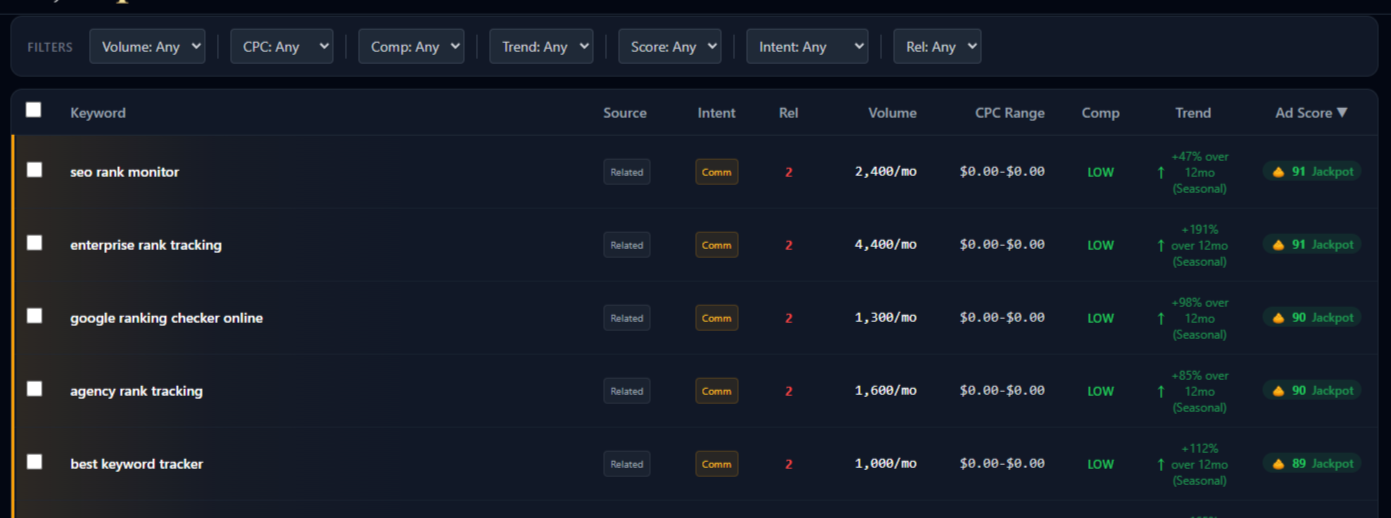
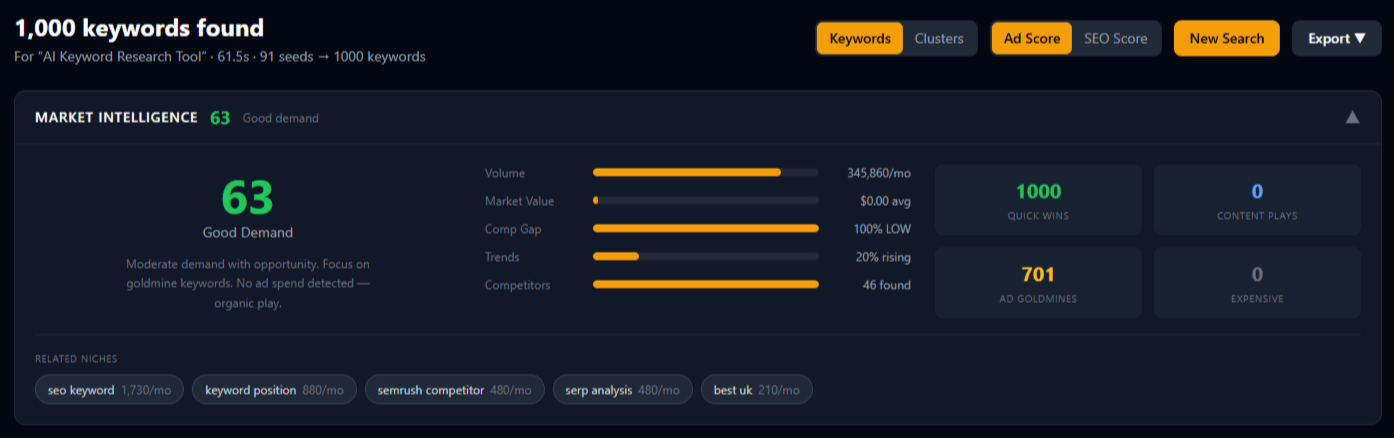
Each keyword comes with real Google Ads data: actual search volume, CPC, competition level, and a Jackpot Score that tells you which keywords are the best opportunities.
What Makes a "Good" Keyword?
The best keywords have this combination:
- Decent volume — at least 100+ searches per month
- Low competition — fewer advertisers or websites competing
- Reasonable CPC — affordable if you're running ads
- Rising trend — growing, not declining
- Clear intent — you can tell what the searcher wants
We call these goldmine keywords — they represent untapped opportunities where you can get traffic without overspending.
What Are the Most Common Keyword Research Mistakes?
1. Only targeting high-volume keywords
Big keywords like "shoes" or "marketing" are impossibly competitive. Long-tail keywords (4+ words) often convert better and cost less. Our guide on finding low competition keywords explains how to identify terms where you can realistically rank.
2. Ignoring search intent
Ranking #1 for "what is email marketing" won't sell your email marketing software. That searcher wants information, not a purchase. Match your content to the intent.
3. Not looking at trends
A keyword with 10,000 monthly searches sounds great — until you realize it peaked 6 months ago and is declining 15% per month.
4. Paying too much for tools
You don't need a $140/month SEO suite to do keyword research. Our comparison of keyword analysis tools shows that tools with real Google Ads data are available for a fraction of enterprise pricing. JackpotKeywords gives you the same data for $9.99/month — or try 3 searches free.
For a deeper look at the tools landscape, see our best free keyword research tools guide, which covers what each free option actually provides versus what it hides behind a paywall. If you are planning Google Ads campaigns specifically, our Google Ads Keyword Planner guide walks through the setup step by step.
Frequently Asked Questions
What is keyword research in simple terms?
Keyword research is the process of finding out what words and phrases people type into search engines when looking for products, services, or information related to your business. It tells you what to write about on your website, what to advertise on in Google Ads, and where the actual demand is in your market. Without it, you are creating content and spending ad budget based on guesses rather than data.
How do beginners do keyword research?
The easiest way to start is to describe your product or service in plain English using a tool like JackpotKeywords, which generates keyword ideas automatically across 12 intent categories. You do not need to know any seed keywords or SEO terminology. You can also use Google Keyword Planner for free by creating a Google Ads account without running any campaigns — our Keyword Planner guide covers the setup process.
Is keyword research still important in 2026?
Yes. Even with AI-powered search features like Google AI Overviews, people still type queries into Google, YouTube, and Amazon billions of times per day. Keyword research tells you exactly what those queries are and how much competition exists, which is essential for both SEO content strategy and paid advertising. The tools and techniques evolve, but the fundamental need to understand search demand remains unchanged.
How many keywords should I target?
Start with 10 to 20 low-competition keywords for a new website. Each keyword should have its own dedicated page or blog post. As your site builds authority over months, you can target more competitive keywords. Quality content targeting fewer keywords beats thin content spread across hundreds of terms. Our guide on finding low competition keywords explains how to choose the right ones to start with.
Start Your First Keyword Research
Ready to find the keywords your business should be targeting? Try JackpotKeywords free — describe your product in plain English and get 1,000+ scored keyword opportunities in under 30 seconds. No credit card required.