Best Free Keyword Research Tools in 2026
· 8 min read · JackpotKeywords Team
An honest comparison of free keyword research tools that actually provide useful data. Which ones work, which ones limit you, and when to upgrade.
Key Takeaway: The best free keyword research tool depends on what data you need. Google Keyword Planner provides the most accurate free data but with volume ranges. Google Trends is best for timing and seasonality. For complete keyword research with exact volumes, free tiers from paid tools offer a better experience than fully free alternatives.
Free keyword research tools are where most businesses start, and many never move beyond them. The question is whether free tools give you enough data to make confident decisions — or whether they save you money while costing you opportunities.
The honest answer is that several free tools provide genuinely useful data. Google Keyword Planner gives you volume and CPC from the source. Google Trends reveals seasonality and trajectory. AnswerThePublic surfaces question-based queries. But every free tool makes tradeoffs — restricted data, limited searches, or missing features — that become more painful as your business grows.
This guide ranks the best free options by what they actually provide, not what their marketing promises.
Which Free Keyword Tools Give Real Search Volume?
Real search volume — actual numbers rather than estimates — is the most valuable data point in keyword research, and it is also the hardest to get for free.
Google Keyword Planner is the only tool that provides Google-sourced volume data at no cost. The limitation is significant: without active ad spend, it shows ranges (1K-10K, 10K-100K) instead of exact numbers. A keyword in the "1K-10K" range could be getting 1,200 searches or 9,800, and that eight-fold difference matters for prioritization. Despite this limitation, it remains the most reliable free data source. Our complete Keyword Planner guide walks through setup and advanced techniques.
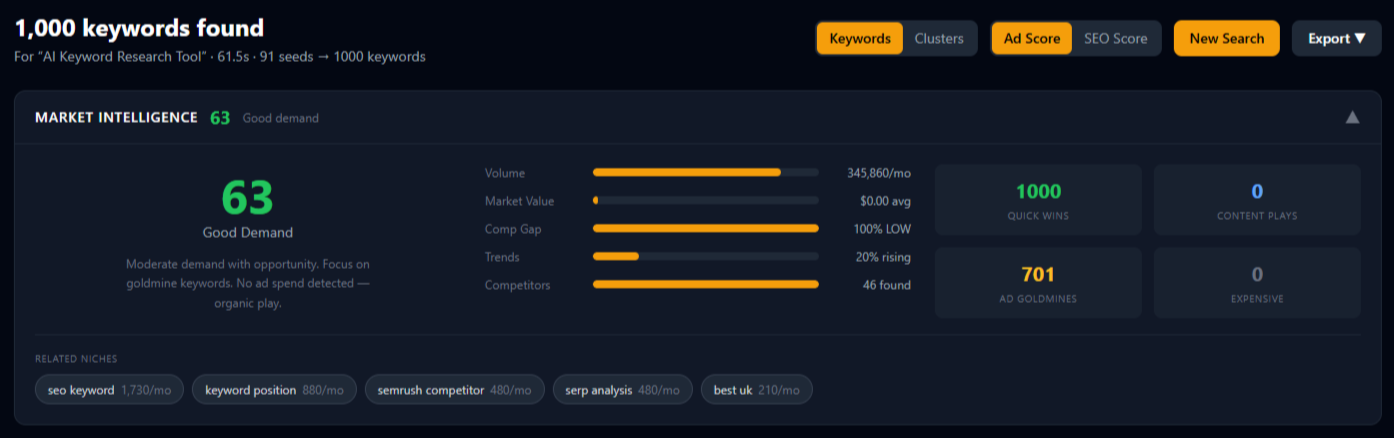
JackpotKeywords (3 free searches) connects to the same Google Ads API as Keyword Planner but returns exact monthly volumes, precise CPC ranges, competition levels, trend direction, and a composite Jackpot Score for each keyword. The free tier includes 3 full searches that generate 1,000+ keywords each across 12 intent categories. It is not unlimited, but the data quality per search is the highest available at zero cost.
Ubersuggest (3 free searches per day) provides estimated volume and keyword difficulty. The data comes from clickstream panels rather than Google directly, which means the numbers can diverge from reality by 30-60 percent. The interface is clean and beginner-friendly, but the data accuracy tradeoff is worth understanding. See our Ubersuggest alternative comparison for a deeper look.
Google Trends does not provide absolute volume numbers but shows relative interest over time on a 0-100 scale. This is perfect for comparing two keywords against each other, identifying seasonal patterns, and spotting rising topics before they peak. It complements volume-based tools rather than replacing them.

How Do Free Tools Compare to Paid Alternatives?
The gap between free and paid keyword tools is not as wide as paid tool marketing suggests, but it exists in specific areas that affect workflow efficiency and decision confidence.
| Feature | Google KP (Free) | JackpotKeywords (3 Free) | Ubersuggest (3/Day) | Trends (Free) | Paid Tools ($29-140) |
|---|---|---|---|---|---|
| Volume data | Ranges | Exact | Estimated | Relative only | Estimated or exact |
| CPC data | Yes (actual) | Yes (actual) | Estimated | No | Varies |
| Intent classification | None | 12 categories | None | None | Basic (4 types) |
| Keyword scoring | None | Jackpot Score | Basic difficulty | None | Difficulty score |
| Daily limit | Unlimited | 3 lifetime | 3 per day | Unlimited | Unlimited |
| Trend data | Minimal | Yes | Limited | Detailed | Varies |
| Clustering | None | Automatic | None | None | Basic |
| AI discovery | None | Yes | None | None | Limited |
The table reveals a pattern: free tools either give you real data with restrictions (Keyword Planner's ranges, JackpotKeywords' 3-search limit) or unrestricted access to estimated data (Ubersuggest's daily allowance, Trends' relative numbers). Paid tools offer unrestricted access to their data, which may or may not be more accurate depending on the tool.
The practical implication is that free tools work well for occasional research — checking a handful of keyword ideas, validating a content topic, or exploring a new niche. When you need to research systematically across multiple topics, compare dozens of keywords confidently, or plan an ad budget with precision, the limitations accumulate.
What Is the Best Free Tool for Beginners?
If you are new to keyword research, the tool matters less than understanding what you are looking at. Volume, CPC, competition, and trends are the four metrics that drive keyword decisions. Any tool that provides at least two of these is useful. Our keyword research beginner's guide covers these fundamentals.
For a first keyword research experience, JackpotKeywords' free tier is the most approachable because it eliminates the seed keyword problem. You describe your product or service in plain English — "handmade soy candles sold on Etsy" or "project management software for remote teams" — and the AI generates keywords across 12 intent categories. You do not need to know what seed keyword to enter because there are no seed keywords.
Google Keyword Planner is the second-best option for beginners, assuming you are comfortable creating a Google Ads account. The interface is designed for advertisers and can feel overwhelming, but the Discover New Keywords feature is straightforward once you find it.
Ubersuggest offers a clean, simple interface that beginners find intuitive. Enter a keyword, see suggestions with metrics. The data accuracy concern is less important for beginners who are learning the process than for experienced marketers making budget decisions.
Google Trends is the easiest tool to use but the hardest to act on alone. It shows you that "cold brew coffee" peaks every summer and "hot cocoa" peaks every winter, but without volume numbers, you cannot assess whether either keyword is worth targeting for your business. Use Trends alongside a volume-based tool rather than as your starting point.
When Should You Upgrade to a Paid Tool?
The upgrade decision should be driven by specific pain points, not by a general sense that paid tools are "better."
Upgrade when volume ranges cost you time. If you are spending 30 minutes per keyword session trying to estimate where keywords fall within Keyword Planner's 1K-10K range — checking Trends for relative comparison, searching Google for result counts, looking at Autocomplete suggestion frequency — a $10/month tool that gives you exact numbers saves more time than it costs.
Upgrade when you need to research more than three topics. JackpotKeywords' free tier gives you three full searches. Each generates 1,000+ keywords, so three searches cover three products, niches, or campaigns comprehensively. If your business spans more topics than that, the $9.99/month unlimited plan is the cost-effective next step.
Upgrade when you are planning real ad spend. If you are about to invest $500 or more per month in Google Ads, making keyword decisions based on estimated data or volume ranges risks misallocating that budget. Exact volume and CPC data from a Google-sourced tool costs a fraction of the ad spend it protects. Our PPC keyword research guide covers how to use exact data for campaign planning.
Do not upgrade just because a tool is popular. SEMrush and Ahrefs are excellent tools, but at $99-140 per month, they only make sense if you use their backlink analysis, rank tracking, and site audit features in addition to keyword research. If keyword research is your primary need, a $10-30/month tool delivers the same keyword data at a fraction of the cost. Our comparison of all major tools helps you match your needs to the right price tier.

Frequently Asked Questions
What is the best completely free keyword research tool?
Google Keyword Planner is the best completely free option because it provides data directly from Google. The tradeoff is volume ranges instead of exact numbers and no SEO-specific features like difficulty scoring or intent classification. For a more capable free experience, JackpotKeywords offers 3 free searches with exact volume, CPC, 12 intent categories, and automatic scoring — enough to research three products or niches thoroughly.
Are free keyword tools accurate enough for business decisions?
Google Keyword Planner is accurate because it uses Google's own data, but the ranges make precise keyword prioritization difficult. Most other free tools use clickstream estimates that can differ from actual numbers by 30-60 percent. For critical decisions — ad budget allocation, content calendar planning, product launch keyword targeting — exact data from a paid tool is worth the modest investment.
When should I upgrade from a free keyword tool to a paid one?
Upgrade when free tool limitations start costing you time or money. Specific triggers include spending excessive time cross-referencing free tools for accurate data, needing to research more than three topics (exceeding JackpotKeywords' free tier), or planning significant ad spend where data accuracy directly affects ROI. At $9.99 per month, the upgrade threshold is lower than most people assume.
Can I do keyword research without any tools?
You can gather basic ideas from Google Autocomplete, People Also Ask boxes in search results, and discussions in forums like Reddit. However, without volume, CPC, and competition data, you cannot evaluate whether those keywords are worth targeting. Even a free tool like Google Keyword Planner adds the quantitative layer needed to move from brainstorming to strategy.
Ready to see what your free searches reveal? JackpotKeywords gives you 3 full searches with exact Google data, 12 intent categories, and automatic scoring. Describe your product, get 1,000+ keyword opportunities in 30 seconds.