SEO Keyword Analysis Tools: 2026 Buyer's Guide
· 9 min read · JackpotKeywords Team
Compare the best SEO keyword analysis tools by data accuracy, features, and price. Find out which tool gives you real search volume and CPC.
Key Takeaway: The best SEO keyword analysis tool depends on what you need. For accurate data at the lowest cost, tools that pull directly from the Google Ads API outperform those using estimated clickstream data. You do not need a $140/month suite if keyword research is your primary use case.
SEO keyword analysis tools help you answer a fundamental question: which keywords should your business target? The right tool shows you search volume, cost-per-click, competition levels, and trend direction for any keyword in your market. The wrong tool gives you estimates that look authoritative but diverge from reality by 30 to 60 percent.
The market is crowded. SEMrush, Ahrefs, Ubersuggest, Mangools, SE Ranking, Google Keyword Planner, and newer AI-powered options like JackpotKeywords all compete for your budget. They range from free to $500 per month, and their data sources, accuracy, and feature sets vary dramatically. This guide cuts through the marketing to help you choose based on what actually matters: data quality, features you will use, and price you can justify.
What Do SEO Keyword Analysis Tools Actually Do?
At their core, keyword analysis tools perform three jobs. First, they help you discover keywords you should consider targeting. Second, they enrich those keywords with metrics — search volume, CPC, competition, trends — so you can evaluate them objectively. Third, they help you prioritize by scoring or ranking keywords based on opportunity.
The discovery mechanism varies significantly across tools. Traditional tools like SEMrush and Ahrefs require you to enter a seed keyword or competitor domain. The tool then expands that seed into related keywords using its proprietary database. This works well if you already know your market, but it creates a cold-start problem for new businesses or unfamiliar niches. If you do not know what seed keyword to enter, the tool cannot help you.
AI-powered tools like JackpotKeywords take a different approach. You describe your product in plain English, and the AI identifies relevant keywords across multiple intent categories — direct searches, competitor brand terms, problem-based queries, seasonal opportunities, and more. This eliminates the seed keyword requirement entirely.
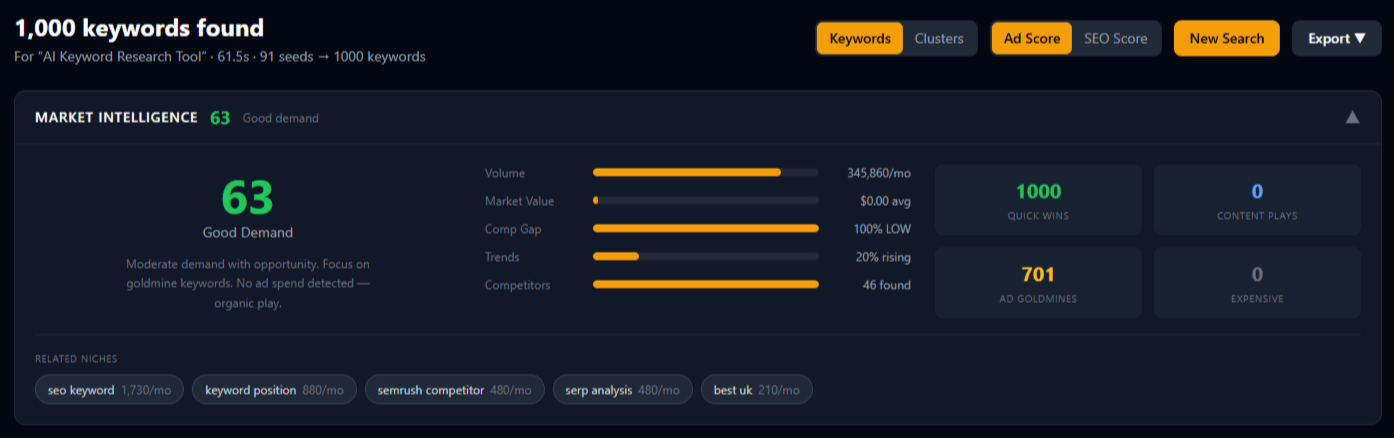
The enrichment step is where data accuracy matters most. Some tools pull from Google directly (Google Keyword Planner, JackpotKeywords), while others estimate volume and CPC using clickstream panels and web scraping (SEMrush, Ahrefs, Ubersuggest). The difference matters when you are making budget decisions — a keyword showing 5,000 monthly searches in Ahrefs might actually have 2,000 in Google's data, or vice versa.
Which Keyword Analysis Tool Has the Most Accurate Data?
Data accuracy is the single most important factor in a keyword tool, and it is also the hardest to evaluate because most tools do not disclose their methodology clearly.
Google Keyword Planner is the gold standard for accuracy because it is Google's own tool reporting its own data. The catch is that it shows search volume as broad ranges (1K-10K, 10K-100K) unless you are actively spending on Google Ads campaigns. It also lacks SEO-specific features like keyword difficulty scoring and intent classification.
JackpotKeywords connects to the same Google Ads API that powers Keyword Planner but returns exact monthly search volumes, precise CPC ranges, and competition levels without requiring an active ad campaign. This gives you the accuracy of Google's data with the usability of a dedicated keyword tool. Our complete guide to Google Keyword Planner explains how the underlying data works.
SEMrush and Ahrefs maintain proprietary keyword databases built from clickstream data, web crawling, and their own panels. These databases are massive — SEMrush claims 25 billion keywords — but the volume estimates can diverge significantly from Google's actual numbers. A 2024 study by Detailed.com found that third-party tools disagreed with each other on search volume by an average of 40 percent for the same keyword.
| Tool | Data Source | Volume Type | CPC Data | Cost |
|---|---|---|---|---|
| Google Keyword Planner | Google Ads API (direct) | Ranges (1K-10K) | Actual bid data | Free |
| JackpotKeywords | Google Ads API (direct) | Exact monthly numbers | Actual bid ranges | $9.99/mo |
| SEMrush | Clickstream + proprietary | Estimated exact | Estimated | $139.95/mo |
| Ahrefs | Clickstream + proprietary | Estimated exact | Estimated | $99/mo |
| Ubersuggest | Clickstream + proprietary | Estimated exact | Estimated | $29/mo |
| SE Ranking | Clickstream + proprietary | Estimated exact | Estimated | $44/mo |
The table above illustrates the fundamental tradeoff: Google-sourced data is more accurate but historically harder to access in a user-friendly format. Third-party tools provide a polished experience but with estimated data. JackpotKeywords bridges this gap by offering Google-sourced data in a purpose-built interface.

How Much Should You Pay for Keyword Analysis?
Pricing in the keyword tool market ranges from free to $500 per month, and the price differences often reflect features you may not need rather than better keyword data.
If your primary need is keyword research — finding keywords, analyzing their metrics, and deciding which to target — you can accomplish that for under $10 per month. JackpotKeywords costs $9.99 per month for unlimited searches with real Google Ads data, AI-powered discovery across 12 intent categories, and automatic keyword scoring. Three searches are free to try.
If you also need backlink analysis, rank tracking, technical site audits, and competitive domain intelligence, you are looking at a full SEO suite. SEMrush starts at $139.95 per month, Ahrefs at $99, and SE Ranking at $44. These prices include keyword research as one feature among many. For a detailed breakdown of how these pricing structures compare, see our keyword tool comparison for 2026.
The common mistake is paying for features you never use. If you run two or three keyword research sessions per week and never touch the backlink analyzer or rank tracker, a $140 monthly subscription means you are paying roughly $17 per keyword session for features gathering dust.
| Use Case | Recommended Tool | Monthly Cost |
|---|---|---|
| Keyword research only | JackpotKeywords | $9.99 |
| Keywords + basic competitor intel | JackpotKeywords or Mangools | $9.99-$29 |
| Full SEO suite (links, rank, audit) | Ahrefs or SE Ranking | $44-$99 |
| Enterprise multi-user SEO | SEMrush | $139.95-$499.95 |
What Features Matter Most in a Keyword Tool?
Beyond data accuracy and price, several features separate useful tools from frustrating ones.
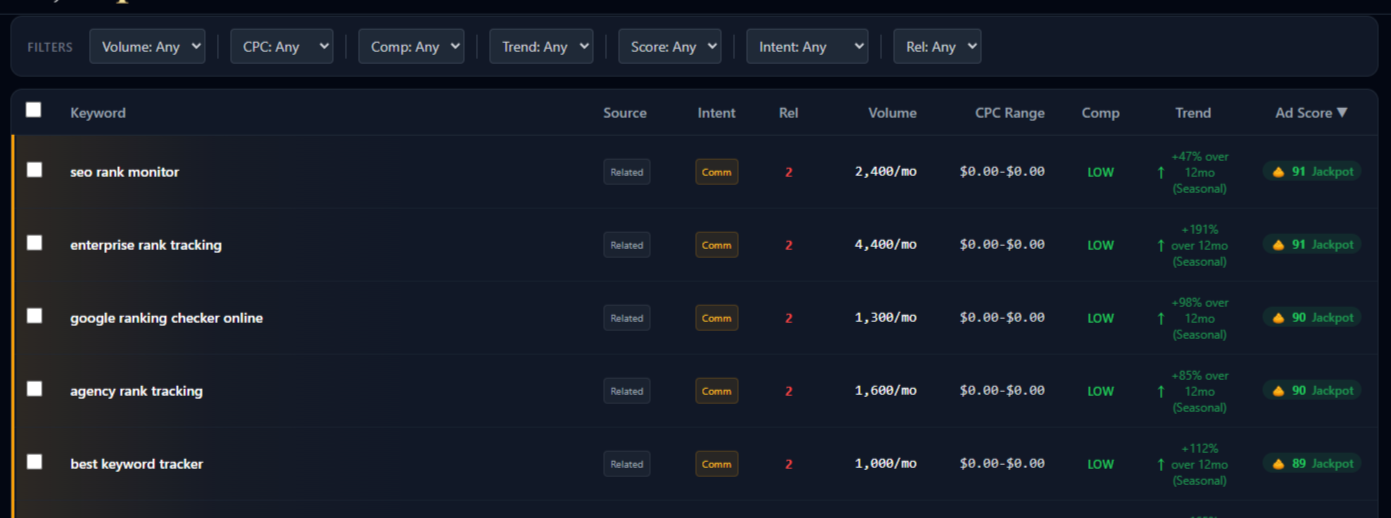
Intent classification tells you why someone searches a keyword — are they looking to buy, compare, learn, or find a specific site? This matters because a keyword with 10,000 monthly searches means nothing if the searchers want information and you are selling a product. JackpotKeywords classifies keywords into 12 intent categories automatically. Most other tools provide basic intent labels (informational, navigational, commercial, transactional) or none at all. Our guide to AI keyword research explains how intent classification shapes your content strategy.
Keyword scoring saves hours of manual analysis. Instead of evaluating each keyword against five separate metrics, a composite score tells you which keywords represent the best opportunities at a glance. JackpotKeywords calls this the Jackpot Score — a 0-100 rating combining volume, CPC, competition, and trend direction. SEMrush offers a Keyword Difficulty score, but it focuses only on ranking difficulty without factoring in commercial value.
Trend data reveals whether a keyword is growing or dying. A keyword with 5,000 monthly searches that is declining 15 percent per month will have half that volume in five months. Conversely, a keyword with 500 searches that is rising 20 percent monthly could reach 1,200 within a year. Tools that show only a static snapshot of volume miss this crucial dimension. For strategies on identifying high-potential keywords before they peak, see our guide on how to find good SEO keywords.
Export and workflow integration determines whether your research translates into action. Can you export to CSV or Excel? Can you filter by multiple criteria simultaneously? Can you group keywords into clusters for content planning? These practical features often matter more than having the largest database.
How Do You Choose Between Free and Paid Tools?
Free tools have a place in every keyword research workflow, but they come with tradeoffs that matter more as your business grows.
Google Keyword Planner is the best free option because it provides real data from Google. However, the volume ranges (instead of exact numbers) make it difficult to prioritize between keywords. Is a keyword with "1K-10K" monthly searches worth targeting? It depends whether the true number is 1,200 or 9,800, and the free version does not tell you. Our comparison of free keyword tools covers what each free option actually provides versus what it hides behind a paywall.
Ubersuggest's free tier gives you three searches per day with limited data — enough to get a taste but not enough for serious research. Google Trends is excellent for comparing relative interest between keywords and spotting seasonal patterns, but it provides no absolute volume or CPC data.
The transition point from free to paid typically comes when you need to make confident decisions. If you are choosing between 50 keywords for a Google Ads campaign or planning a content calendar for the next quarter, estimated ranges and limited daily searches become a bottleneck. At that point, $9.99 per month for unlimited exact-data searches is one of the lowest-cost ways to remove that bottleneck.
Frequently Asked Questions
What is the best SEO keyword analysis tool for beginners?
JackpotKeywords is the most beginner-friendly option because it does not require you to know seed keywords. You describe your product in plain English and the AI generates keyword opportunities across 12 intent categories, complete with real Google Ads data. Three searches are free with no credit card required. If you want to start with the fundamentals first, our beginner's guide to keyword research covers everything you need to know.
Do free keyword analysis tools give accurate data?
Google Keyword Planner is the most accurate free option since it pulls directly from Google, but it shows volume as ranges unless you run active ad campaigns. Most other free tools use estimated clickstream data that can diverge from actual numbers by 30 to 60 percent. JackpotKeywords uses the same Google Ads API as Keyword Planner but returns exact figures for $9.99 per month.
How much should I pay for a keyword analysis tool?
If you only need keyword research, expect to pay between $10 and $30 per month. Tools like JackpotKeywords cost $9.99 per month for unlimited searches with real Google Ads data. Full SEO suites that include backlinks, rank tracking, and site audits run $99 to $140 per month. Only pay for features you will actually use — our SEMrush comparison breaks down exactly where the price difference comes from.
What is the difference between keyword research and keyword analysis?
Keyword research is the discovery phase where you find keywords relevant to your business. Keyword analysis is evaluating those keywords using metrics like search volume, CPC, competition, and trends to decide which ones are worth targeting. Most modern tools combine both into a single workflow, but the distinction matters when comparing tools — some excel at discovery while others focus on analysis of keywords you already know about.
Ready to see how your keywords stack up? JackpotKeywords analyzes keywords with real Google Ads data across 12 intent categories. Describe your product, get 1,000+ scored opportunities in 30 seconds. Three searches are free.