How to Find Good SEO Keywords (Without Paying $140/mo)
· 8 min read · JackpotKeywords Team
Find high-traffic, low-competition SEO keywords without expensive tools. A practical guide for small businesses and entrepreneurs.
Key Takeaway: You do not need a $140/month SEO suite to find high-quality keywords. Tools that use Google Ads API data provide the same accuracy as enterprise platforms at a fraction of the cost. The key is focusing on low-competition keywords with clear intent rather than chasing high-volume head terms.
Finding good SEO keywords is the single most impactful thing you can do for your website's organic traffic. The right keywords bring visitors who are actually interested in what you offer. The wrong keywords bring nobody — either because the competition is too fierce or because the searchers want something different than what you provide.
The good news is that effective keyword research does not require expensive tools. This guide shows you how to find high-traffic, low-competition keywords using affordable approaches, with real examples and specific metrics to look for.
The Keyword Research Pricing Problem
If you have ever looked into keyword research tools, you have probably experienced sticker shock. Here is what the major platforms charge:
| Tool | Monthly Price | Annual Price |
|---|---|---|
| SEMrush | $139.95/mo | $1,679/yr |
| Ahrefs | $99/mo | $1,188/yr |
| Moz Pro | $99/mo | $1,188/yr |
| Mangools (KWFinder) | $49/mo | $588/yr |
For an SEO agency or a large enterprise, these prices are a rounding error. But for a small business owner, a solopreneur, or someone launching their first online product, spending $100 or more per month on keyword research before you have made a single dollar from SEO is a tough sell.
The good news: you do not need expensive tools to find excellent SEO keywords. You need a clear methodology and a tool that gives you real data without the enterprise price tag. This guide covers both.
What Makes a Keyword "Good" for SEO?
Before we get into tactics, let us define what we are looking for. A good SEO keyword is not just a popular search term. It is a term where the opportunity outweighs the effort. Specifically, a good keyword has five qualities:
1. Sufficient Search Volume
The keyword needs enough monthly searches to be worth creating content for. The threshold depends on your niche — in a broad consumer market, you might want 1,000+ monthly searches. In a specialized B2B niche, 100 monthly searches could represent significant revenue.
There is no universal minimum, but here is a practical framework:
| Business Type | Minimum Monthly Volume Worth Targeting |
|---|---|
| E-commerce (broad) | 500+ |
| E-commerce (niche) | 100+ |
| Local service business | 50+ |
| B2B / SaaS | 100+ |
| Blog / content site | 300+ |
2. Low to Medium Competition
Competition tells you how hard it will be to rank on the first page of Google. If the top 10 results are dominated by Amazon, Wikipedia, and major publications, a small site has almost no chance of breaking through — regardless of content quality.
Look for keywords where the search results include smaller sites, forums, or thin content that you can clearly improve on.
3. Rising or Stable Trend
A keyword with 2,000 monthly searches that is declining 15% per month will be at 850 searches within a year. Meanwhile, a keyword at 500 searches growing 10% per month will be at 970 within a year. Always check trend direction before investing time in content.
4. Clear Search Intent
You need to know what the searcher actually wants. "Running shoes" could mean someone wants to buy shoes, read reviews, learn about shoe technology, or find a local store. The more specific the keyword, the clearer the intent:
- Vague: "running shoes" (intent unclear)
- Clear: "best running shoes for plantar fasciitis 2026" (comparison/purchase intent)
- Clear: "how to choose running shoes for beginners" (informational intent)
Clear intent lets you create content that precisely matches what the searcher needs, which Google rewards with higher rankings.
5. Relevance to Your Business
This seems obvious, but many businesses chase high-volume keywords that are only tangentially related to what they sell. A keyword is only good if the person searching for it could realistically become your customer.
The Free Method: Manual Keyword Research
You can find good keywords without any paid tools at all. It takes more time, but it works. Here is the process:
Step 1: Brain Dump Your Seed Topics
Write down every topic, question, and problem related to your business. Think about:
- What do customers ask you before they buy?
- What problems does your product or service solve?
- What do people call your product category?
- What would someone search for right before they need you?
Step 2: Use Google Autocomplete
Go to Google and start typing each of your seed topics. Google will suggest completions based on what people actually search for. These suggestions are gold — they represent real search behavior.
Type "organic dog food" and you might see:
- organic dog food brands
- organic dog food for sensitive stomach
- organic dog food delivery
- organic dog food vs regular
Each suggestion is a potential keyword. Write them all down.
Step 3: Check "People Also Ask"
Search for your seed keywords and look at the "People Also Ask" box in the search results. These are questions real people ask, and each one represents a content opportunity.
Step 4: Analyze the Search Results
For each keyword candidate, look at the actual search results. Ask yourself:
- Are the top results from massive, authoritative sites? (Hard to compete)
- Do any smaller sites or forums rank? (Easier to compete)
- Is the existing content thin, outdated, or low quality? (Opportunity)
- Are there ads on the page? (Indicates commercial value)
Step 5: Cross-Reference with Google Trends
Go to trends.google.com and check each keyword's trend direction. Filter for the past 12 months. You want to see a flat or upward line — avoid anything declining.
The Problem with the Free Method
This process works, but it has serious downsides:
- It is extremely slow. Researching 50 keywords this way can take an entire day.
- You miss keywords you never thought of. Manual brainstorming is limited by your own vocabulary and assumptions.
- You get no precise volume data. Google Autocomplete and Trends show relative popularity, not actual monthly search numbers.
- There is no scoring or prioritization. You end up with a list of keywords but no way to quickly identify which ones are the best opportunities.
The Budget-Friendly Method: Real Data Without the Enterprise Price
Between the free manual method and the $140/month enterprise tools, there is a middle ground. Modern AI-powered tools can deliver the same core data — real search volumes, CPC, competition levels, and trend indicators — at a fraction of the cost.
JackpotKeywords was built specifically for this use case: businesses that need serious keyword data without the enterprise budget. At $9.99/month, it costs less than 10% of what SEMrush charges — and you can try it with three free searches before paying anything.
Here is what changes when you use a modern keyword tool instead of the manual method:
| Manual Method | With JackpotKeywords |
|---|---|
| Hours of brainstorming | Describe your product in plain English |
| Limited by your vocabulary | AI discovers keywords across 12 intent categories |
| No real volume numbers | Real Google Ads volume data |
| No competition data | Google Ads competition ratings |
| Manual trend checking | Trend indicators included |
| No prioritization | Jackpot Score ranks every keyword |
| 50-100 keywords per day | 1,000+ keywords in under 30 seconds |
How the Jackpot Score Identifies Good Keywords Automatically
The hardest part of keyword research is not finding keywords — it is figuring out which ones to pursue first. This is where manual methods break down and where a scoring system becomes essential.
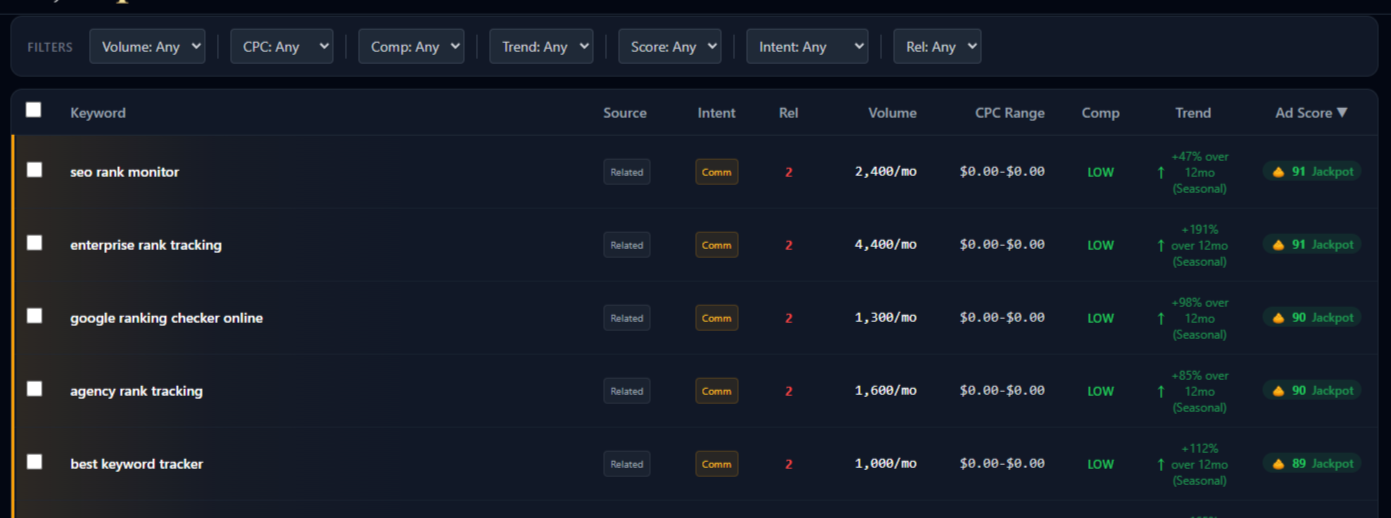
The Jackpot Score combines the five qualities we defined earlier — volume, competition, CPC, trends, and intent — into a single number. Keywords with high scores have the best combination of high opportunity and low difficulty.
Here is an example of how scoring changes your perspective. Imagine you are researching keywords for a meal prep delivery service:
| Keyword | Volume | Competition | CPC | Trend | Jackpot Score |
|---|---|---|---|---|---|
| meal prep delivery | 18,100 | HIGH | $4.20 | Stable | 42 |
| healthy meal delivery service | 6,600 | HIGH | $5.80 | Stable | 38 |
| meal prep delivery for weight loss | 720 | LOW | $1.90 | Rising | 87 |
| affordable meal prep service near me | 480 | LOW | $1.45 | Rising | 91 |
| meal prep for busy professionals | 390 | LOW | $0.85 | Rising | 89 |
Without scoring, most people would chase "meal prep delivery" because it has the highest volume. But the Jackpot Score shows that the lower-volume keywords are significantly better opportunities — low competition, affordable CPCs, and rising trends. These are the keywords where a small business can actually win.
The Price Comparison Reality
Let us put this in concrete terms. Suppose you commit to six months of keyword research to build out your SEO strategy:
| Tool | 6-Month Cost | What You Get |
|---|---|---|
| SEMrush | $839.70 | Full suite (most features unused) |
| Ahrefs | $594.00 | Full suite (most features unused) |
| Manual (free) | $0 | No real data, very slow |
| JackpotKeywords | $59.94 | Real data, AI discovery, scoring |
Most small businesses use less than 20% of what SEMrush and Ahrefs offer. You are paying for backlink analysis, site audits, rank tracking, and dozens of other features when all you needed was keyword research. It is like buying a commercial kitchen when you just need a good knife.
5 Practical Strategies for Finding SEO Keywords on a Budget
Strategy 1: Start with Problems, Not Products
Instead of searching for your product name, search for the problems your product solves. "Back pain from office chair" will surface different (and often better) keywords than "ergonomic office chair."
Strategy 2: Mine Your Competitors' Weaknesses
Look at the search results for your main keywords. Find competitors who rank with thin or outdated content. Those are the keywords where you can create something better and outrank them. You do not need a paid tool to do this — just search and evaluate.
Strategy 3: Target Long-Tail Keywords First
Long-tail keywords (4+ words) are almost always easier to rank for and convert at higher rates. "Best CRM for real estate agents" converts better than "CRM software" and has a fraction of the competition.
Strategy 4: Look for Rising Keywords
Keywords in emerging trends have low competition because most competitors have not discovered them yet. Google Trends is free for this, though tools like JackpotKeywords surface rising keywords automatically with each search.
Strategy 5: Group Keywords by Intent Category
Not every keyword should lead to the same page. Group your keywords by intent:
- Informational keywords (how to, what is, guide) — Write blog posts
- Commercial keywords (best, review, comparison, vs) — Create comparison pages
- Transactional keywords (buy, order, pricing, near me) — Optimize product/service pages
This ensures every keyword you target has a clear content strategy behind it.
What Most People Get Wrong
The biggest mistake in keyword research is optimizing for volume alone. A keyword with 50,000 monthly searches is worthless to your business if you never rank for it. Meanwhile, ranking #1 for ten keywords with 200 monthly searches each gives you 2,000 visitors per month — visitors who came from low-competition, high-intent searches and are far more likely to convert.
The second biggest mistake is paying for tools you do not fully use. If you are a small business doing keyword research — not running an SEO agency — you do not need a $140/month platform. You need real data, smart scoring, and the ability to discover keywords you would never have thought of on your own.
For a detailed walkthrough of Google's own free tool, see our Google Keyword Planner guide. If you want to compare all the free options side by side, our best free keyword research tools guide covers what each actually provides. And if you are specifically looking for keywords with minimal competition, our low competition keywords guide walks through the validation process step by step.
Frequently Asked Questions
How do I find good SEO keywords for free?
Google Keyword Planner provides real keyword data at no cost, though it requires a Google Ads account and shows volume as ranges rather than exact numbers. Google Autocomplete and People Also Ask boxes in search results surface real query ideas that reflect actual search behavior. JackpotKeywords offers 3 free searches with exact volume, CPC, 12 intent categories, and automatic scoring for 1,000+ keywords per search — enough to research three niches thoroughly.
What makes a keyword good for SEO?
A good SEO keyword has meaningful search volume (at least 100 monthly searches), low to medium competition, clear search intent that matches the content you plan to create, and ideally a stable or rising trend. The combination of these factors determines a keyword's value — a term with moderate volume but low competition and strong buying intent is more valuable than a high-volume term you will never rank for.
Do I need expensive tools to find SEO keywords?
No. Google Keyword Planner is free, and JackpotKeywords costs $9.99 per month for unlimited searches with real Google Ads data, AI-powered discovery, and 12 intent categories. You do not need a $140 per month SEO suite unless you also need backlink analysis, rank tracking, and technical site audit features. Our keyword analysis tools guide breaks down exactly which features justify which price points.
Start Finding Keywords Today
Good SEO keywords are not hidden behind expensive paywalls. They are hidden in plain sight — in the gap between what your competitors target and what your customers actually search for. The right tool helps you find that gap faster.
Try JackpotKeywords free — describe your business in plain English and get 1,000+ scored keyword opportunities with real Google Ads data. Three free searches, no credit card required. Plans start at $9.99/month — less than a single lunch.